 Polymers can be synthesized and/or modified in a supercritical fluid medium. Most polymers show some solubility, plasticization, or swelling in supercritical fluid media. Depending on the choice of polymer-SCF medium, the degree of solubilization, plasticization, or swelling varies widely.
A well publicized example of polymerization involves that of fluoropolymers. However, the process should not be limited to fluoropolymers, since lower molecular weight polymers of most monomeric origins show some level of solubilization in a chosen (preferred) solvent. Further, most initiators and other participants of reactions are quite soluble in proper supercritical fluid solvents, thus creating a homogeneous or near-homogeneous reaction environment. Homogeneous reaction environments promote noncatalytic, but fast reactions. Such benefits can be further exploited using the basic operating principles of precipitation polymerization or suspension polymerization. We have developed a novel technology for supercritical fluid polymerization of fluoromonomer, achieving unique properties in resultant polymer, including average molecular weight and its distribution mode.
- Lee, H. B. Lanterman, A. Sardesai, J. Wenzel, B. Marshall, J. Yen, R. Amin-Sanayei, and M. Moucharik, “Polymerization of Poly(vinylidene fluoride) in a Supercritical Fluid Medium”, U.S. Patent No. 7,091,288, August 15, 2006.
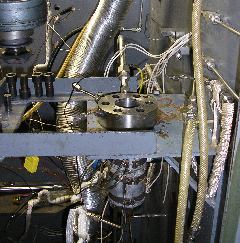 In a different polymeric system, Dr. Lee’s research group developed a novel process technology where polymerization can be carried out with controllability of molecular weight distribution (MWD).
- S. Lee, H. B. Lanterman, K. L. Fullerton, and P. Pettit, “Polymerization, Compatibilized Blending, and Particle Size Control of Powder Coatings in a Supercritical Fluid”, U.S. Patent No. 6,340,722, January 22, 2002.
- S. Lee, H. B. Lanterman, K. L. Fullerton, and P. Pettit, “Polymerization, Compatibilized Blending, and Particle Size Control of Powder Coatings in a Supercritical Fluid”, U.S. Patent No. 6,849,678, February 1, 2005.
Other successful examples involve graft copolymerization in a supercritical fluid medium. In a supercritical fluid medium, the effective glass transition temperature for the base polymer is significantly reduced and the permeability of the active monomer is substantially enhanced. Graft levels of 1-8% by weight were obtained for a variety of graft copolymers. They include PP-g-PS, PP-g-AA, PS-g-AA, PVC-g-PS, PVC-g-VAc, PVDF-g-MA, etc. For this process, a U.S. patent has been obtained.
- S. Lee, S. Kwak, and F. O. Azzam, “Graft Copolymerization in Supercritical Fluid Media”, U.S. Patent No. 5,663,237, September 2, 1997.
For related subjects in graft copolymers, please visit here. This technology, is available for licensing through the Temarex Corporation, a technology transfer company for the University of Akron. For further R&D on this or related novel process development, please contact us.

